August 22, 2011
Citation: Nat’l Day Laborer Org. Network v. U.S. Immigration and Customs Enforcement Agency, 10 Civ. 3488, 2011 WL 381625 (S.D.N.Y. Feb. 7, 2011)
e-Lesson Learned: Metadata is an integral part of an electronic record, so it should not be stripped from PDFs and other productions of electronic public records under FOIA.
Twitter This: Agencies: SDNY rules that metadata is part of an electronic public record – are you properly handling FOIA requests?
Metadata includes those properties related to electronic files in their original format, such as the original identifier/file name, custodian, source/file directory, modified date and time, creation date and time, time offset value, etc. In a precedent-setting opinion in the Southern District of New York, Judge Scheindlin (thinking Judge Judy? Not that Judge Scheindlin!) held that certain metadata is part of an electronic public record and subject to disclosure under discovery rules as well as the Freedom of Information Act (“FOIA”).
Continue reading »
 No Comments » |


 More...
|
More...
|  Permalink
 Tagged as: Accessibility, Discoverability, Metadata, Procedure
View more articles implicating: Employees, Government Officials
June 16, 2011
Citation: In re Grand Jury Subpoenas, 627 F.3d 1143 (9th Cir. Cal. 2010)
Employee/Employer Implicated: Government official, Outside counsel, Miscellaneous
e-Lesson Learned: Non-privileged information originating outside the U.S. that you had to produce as a result of discovery from a civil antitrust suit can get into the hands of a grand jury and be used against you in an antitrust investigation.
Twitter This: Note, discovery in civil litigation can move information within the grasp of the grand jury - and there is nothing you can do about it.
Be careful when you defend a civil suit that was triggered by a government investigation! When you respond to discovery requests and produce material which was previously not within the reach of the grand jury, the government can subpoena these documents! A civil protective order will not do you any good! The defendants in In re Grand Jury Subpoenas had to find that out the hard way. Continue reading »
No Comments » | More...
| Permalink
Tagged as: Accessibility, Discoverability, Good Faith, Privilege, Work-Product Doctrine
View more articles implicating: Government Officials, Miscellaneous, Outside Counsel
April 3, 2011
Citation: Estate of Davis v. Spriggs, 2010 WL 4817348 (Delaware County Nov. 19, 2010)
e-Lesson Learned: Having an “Evidence Eliminator” program which destroys electronic data on a computer upon start-up can justify incidental deletion of evidence when your job involves sensitive information.

Again with the scandalous sex tapes? Seriously? With all the publicity surrounding leaked sex tapes coupled with the prevalence and ease of digital communication, one cannot honestly believe such a tape will remain a well kept secret. You’ll receive no sympathy on this blog for your escapades, and you’ll receive no sympathy in the Ohio court system, either.
In Davis v. Spriggs, Spriggs was suing her former husband (Davis) for posting pictures and video on an adult website after the divorce settlement, signed a few months prior, specifically prohibited such distribution. Spriggs discovered these pictures after logging into a members-only adult website which sent her enough email spam she just had to check it out. Whilst cruising the racy adult website she also discovered pictures of her ex’s new girlfriend. Continue reading »
6 Comments | More...
| Permalink
Tagged as: Accessibility, Admissibility, Chain of Custody, Computer Forensics Protocols, Discoverability, Experts, Good Faith, Legal Hold/Preservation, Privilege, Procedure, Production of Data, Sanctions, Spoliation, Work-Product Doctrine
View more articles implicating: Employees, Government Officials, Information Technology Professionals, Miscellaneous
March 13, 2011
Citation: In re Grand Jury Subpoenas, 2010 U.S. App. LEXIS 24893 (9th Cir. Cal. Dec. 7, 2010).
Employee/Employer Implicated: Law Firms, Companies engaged in price fixing and other antitrust violations
e-Lesson Learned: Don’t engage in illegal price fixing . . . but if you do, don’t import the evidence into the United States, too!
Twitter This: Don’t engage in illegal price fixing . . . but if you do, don’t import the evidence into the United States, too! http://ellblog.com/?p=2256
For foreign companies doing business in the United States, avoiding getting sued may be hard enough without having to worry about whether you’re being investigated by a grand jury and the U.S. Department of Justice.
However, life can be really difficult for foreign companies that are not only getting sued, but also have to turn over their civil litigation documents for investigations of possible criminal conduct.
Under a recent 9th Circuit ruling, this is exactly the kind of misfortune that has befallen several foreign LCD manufacturers. The foreign companies, including LG Display, Sharp, and Chunghwa Picture Tubes, are embroiled in an antitrust class action suit and are simultaneously being investigated for antitrust criminal behavior.
Even though it couldn’t find any precedent to support its decision, the court ruled that if the documents were in the country, they were within the “grasp” of the grand jury.
The 9th Circuit’s ruling comes as a big victory for the DOJ. It gives prosecutors expanded power to subpoena foreign documents that have entered the country for civil litigation purposes.
Continue reading »
1 Comment | More...
| Permalink
Tagged as: Discoverability, Legal Hold/Preservation, Procedure, Production of Data, Work-Product Doctrine
View more articles implicating: Employees, Government Officials, Miscellaneous, Outside Counsel, Owners/Executives, Upper Management
January 24, 2011
Citation: Swofford v. Eslinger, 671 F. Supp. 2d 1274; 2009 U.S. Dist. LEXIS 111064 (September 28, 2009)
e-Lesson Learned: Willful disregard of obligation to preserve evidence is bad faith that substantially prejudices the plaintiff.
Twitter This: Defendant ignores litigation hold memo; slapped with adverse inference instruction and fees --> http://ellblog.com/?p=2210
Yet again, defendants’ bad faith costs them dearly. In Swofford v. Eslinger, Robert Swofford brought a § 1983 claim and state law claims of battery, negligent training, and supervision against defendants William Morris and Ronald Remus, two Deputies for the Seminole County Sheriff’s Office (“SCSO”), and Donald Eslinger, the Sheriff of Seminole County, State of Florida. Swofford was shot seven times by the Deputies on his own property after being misidentified as a burglar, and spent six weeks in the hospital.
Swofford’s attorney sent two letters to SCSO requesting that all evidence related to the shooting be maintained in its original order. Upon receipt of the letters, SCSO never issued any directives or “litigation hold memos” to prevent the destruction of relevant evidence. The senior members of SCSO who saw the two letters from Swofford’s attorney did not communicate with any other employees of SCSO to maintain evidence relevant to Swofford’s case.
Continue reading »
No Comments » | More...
| Permalink
Tagged as: Good Faith, Legal Hold/Preservation, Sanctions, Spoliation
View more articles implicating: Employees, Government Officials
November 4, 2010
Citation: United States v. Bari, 09-1074-cr
Employee/Employer Implicated: Counsel, Plaintiffs, Defendants, and Basically Anyone Appearing Before a Judge
e-Lesson Learned: The Federal Rule of Evidence do not prohibit a judge from using Google to confirm his intuition regarding a “matter of common knowledge”
Twitter This: Judge uses Google in his chamber to verify a matter of common knowledge --> http://ellblog.com/?p=2149
How often are you pretty sure you are right about something – be it directions, a phone number, how many rounds there are in the NFL draft, etc – but you take a few seconds to make sure by running a Google search? This happens all the time; it is why Google is so great. You can be 90% sure about something, take 20 seconds to check Google, and then be 100% sure. It seems like everyone uses Google, the word has become a verb: “I think the Court’s filing deadline is 5pm, I’ll just Google it to make sure.”
So, if everyone uses Google to verify simple everyday facts, why can’t a judge do so with respect to judicial notice? In U.S. v. Bari, the second circuit reviewed the district court’ decision to verify “a matter of common knowledge” by running a quick Google search. Continue reading »
No Comments » | More...
| Permalink
Tagged as: Accessibility, Computer Forensics Protocols, Procedure
View more articles implicating: Government Officials, Miscellaneous
October 17, 2010
Employee/Employer Implicated: Information Technology Managers, Outside Counsel, Criminal Defendants and Prosecutors
e-Lesson Learned: The Court will award serious, dispositive sanctions when a party recklessly destroys evidence, which would have resolved a key dispute in the case.
Twitter This: Excessive force, reckless spoliation, excessive sanctions? --> http://ellblog.com/?p=2137
When a police department loses its own videotape of the arrest of a citizen, and the evidence that was on that tape is a key issue in the case, the police department will face very serious sanctions that could be dispositive on the issue. In this civil litigation in which the key issue was whether excessive force was used during the arrest, the lost videotape would have showed the arrest and resolved the key issue in dispute. After weighing several factors, the Court imposed a dispositive sanction in which it designated that the police did use excessive force in the arrest.
Walter Peschel was arrested after a rather odd series of events. While tending the lawn at an apartment complex he owned, Peschel, a doctor, was asked to assist a tenant who sat in her car nearly unconscious from a prescription drug overdose, armed with a gun, and threatening to kill herself. Continue reading »
No Comments » | More...
| Permalink
Tagged as: Legal Hold/Preservation, Production of Data, Sanctions
View more articles implicating: Criminal Defendants, Government Officials, Information Technology Professionals
September 24, 2010
Twitter This: Virtual Crimes – Real Damages: Challenges Posed By Electronic Crimes In The United States --> http://ellblog.com/?p=2125
A dangerous aspect of the Internet Age that businesses and governments must cope with is cybercrime. As technology advances, so do the criminals. For American businesses, and both federal and state governments, the potential cost of these attacks is staggering.
“Electronic Crime” or “Cybercrime,” broad terms used to describe criminal activity conducted through the Internet, began almost as soon as the Internet came into being. The complexities of the schemes have proven dynamic, evolving to meet the increased security measures employed by both business and government. Today, attacks on businesses can include such things as the theft of intellectual property, seizing bank accounts, generating and distributing malware, and other forms of disruptive cybercrimes. Cyber attacks against the federal government can have an even greater negative impact, potentially devastating the country’s technical infrastructure or leading to the exposure of highly classified information. In 2009, the Director of National Intelligence, testifying before the Senate Select Committee on Intelligence, explained that foreign nations and cybercriminals were targeting both the government and private sector in an effort to gain competitive advantages, or to disrupt or destroy them. Perhaps most disturbing is that terrorist groups have signaled a desire to use cyber attacks against the United States government. And for state governments, the concern is just as great. While the weak American economy has caused most states to severely trim their budgets, reducing their ability to devote expenditures to cyber defense, they remain an appealing target for cybercriminals, as their computer systems hold some of their citizens’ most vital records, including health and driving records, educational and criminal records, professional licenses, and tax information. Now more than ever, governments and businesses must be aware of this evolving threat, and take proactive measures to counter it.
In this article, we will endeavor to explain what cybercrimes are, profile the cybercriminal, provide discussion of some of the most common forms of cybercrimes affecting businesses and government, and discuss action that the government is taking to fight back.
Continue reading »
No Comments » | More...
| Permalink
View more articles implicating: Government Officials, Miscellaneous, Owners/Executives
September 10, 2010
Twitter This: Crimes Are Virtual But Damages Are Real: World Gathers In Brazil 4 The Congress On Electronic Crimes & Protection http://ellblog.com/?p=2110
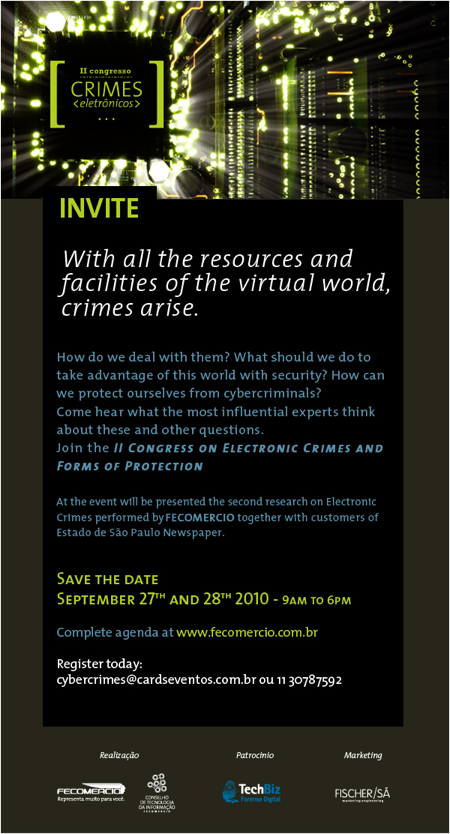
Recently, our very own Fernando M. Pinguelo was able to sit down with Brazillian Cyber Law Attorney Opice Blum for a discussion on the Congress on Electronic Crimes and Protection. Below is a partial transcript of their Question-and-Answer session:
Q: Thank you, Renato, for sitting down with me to discuss the latest developments in tech crimes and what experts like you are doing to help businesses and individuals prevent these crimes and address them when they hit home. Tell me a little bit about your background and the composition of your law practice.
A: My name is Renato Opice Blum and I am a Brazilian Attorney and Economist who specializes in High Tech Law. I am CEO of Opice Blum Attorneys at Law, one of the most respected South American firms. Continue reading »
No Comments » | More...
| Permalink
Tagged as: Accessibility, Computer Forensics Protocols, Events, Experts, Metadata, Privacy
View more articles implicating: Government Officials, Miscellaneous